How to Fix a Muddy, Sloping Garden in West Yorkshire: Drainage and Levelling Done Right
Sloping garden drainage problems in West Yorkshire? We explain what causes them and how we fix them properly. Free quotes in Huddersfield and Barnsley.
A sloping garden in West Yorkshire is not a problem. A poorly drained one is.
Slopes are part of life in West Yorkshire. The topography around Huddersfield and Barnsley means a flat back garden is actually the exception. Most plots we visit have some gradient to them, whether that is a gentle fall from the house toward the back fence, or a steep bank that has been left to do whatever it likes for years. That is fine. A slope, handled correctly, drains beautifully. The same slope, left without proper groundwork, turns into a muddy slide every time it rains.
And it rains here. A lot.
We have spent over 20 years working on gardens across West Yorkshire and South Yorkshire, and the single most common call we get after a wet spell is from homeowners standing at the back door looking at a garden that is half mud, half standing water. This article explains what is actually happening, why it gets worse over time, and what a proper fix looks like.
Why sloping gardens in West Yorkshire drain so badly
The short answer is clay. A huge proportion of the soil across West Yorkshire and South Yorkshire sits on heavy clay subsoil. Clay does not drain. Water hits it, pools on top of it, and has nowhere to go. On a flat garden, that means soggy patches. On a slope, it means that water moves, fast, and takes topsoil with it.
Add to that the fact that many gardens around Huddersfield and Barnsley were never properly landscaped in the first place. They were levelled with whatever fill was to hand, seeded, and left. No drainage layer, no channel, no thought given to where water would go. That works for a few years. Then the soil compacts, the grass thins out, and every autumn the garden becomes unusable.
A few things make it worse:
- Compacted ground. Foot traffic over years pushes clay particles together until the surface is almost impermeable.
- No fall away from the house. Water runs toward the foundations rather than away from them.
- Broken or absent soakaways. Older properties in Huddersfield and Barnsley often have drainage that has either collapsed or was never adequate.
- Retaining structures that block natural flow. A badly built wall or raised bed can act like a dam, pooling water in the wrong place.
What we look at before we touch a spade
Every sloping garden drainage job starts the same way for us: we walk the plot and read it. Where is the water coming from? Where is it going? What is happening underneath?
We check the fall of the land relative to the house. The ground should always fall away from the building. If it does not, or if it has settled back toward the foundations over time, that is the first thing to address. Water sitting against a house wall is not just a garden problem.
We look at what is already there. Is there an existing soakaway? Is there a drain at the bottom of the slope? Is there a neighbour's fence acting as a barrier? All of these things affect what solution is right.
We check the soil. Clay-heavy ground in West Yorkshire needs a different approach to sandy or loamy soil. You cannot just lay a French drain and hope for the best if the surrounding soil cannot absorb water at any useful rate.
Only once we understand the site do we talk about what needs doing.
The fixes that actually work for sloping garden drainage in West Yorkshire
There is no single answer. A garden in Barnsley with a 1-in-5 slope and solid clay needs different treatment to a Huddersfield terrace garden with a modest fall and compacted topsoil. But the principles are consistent.
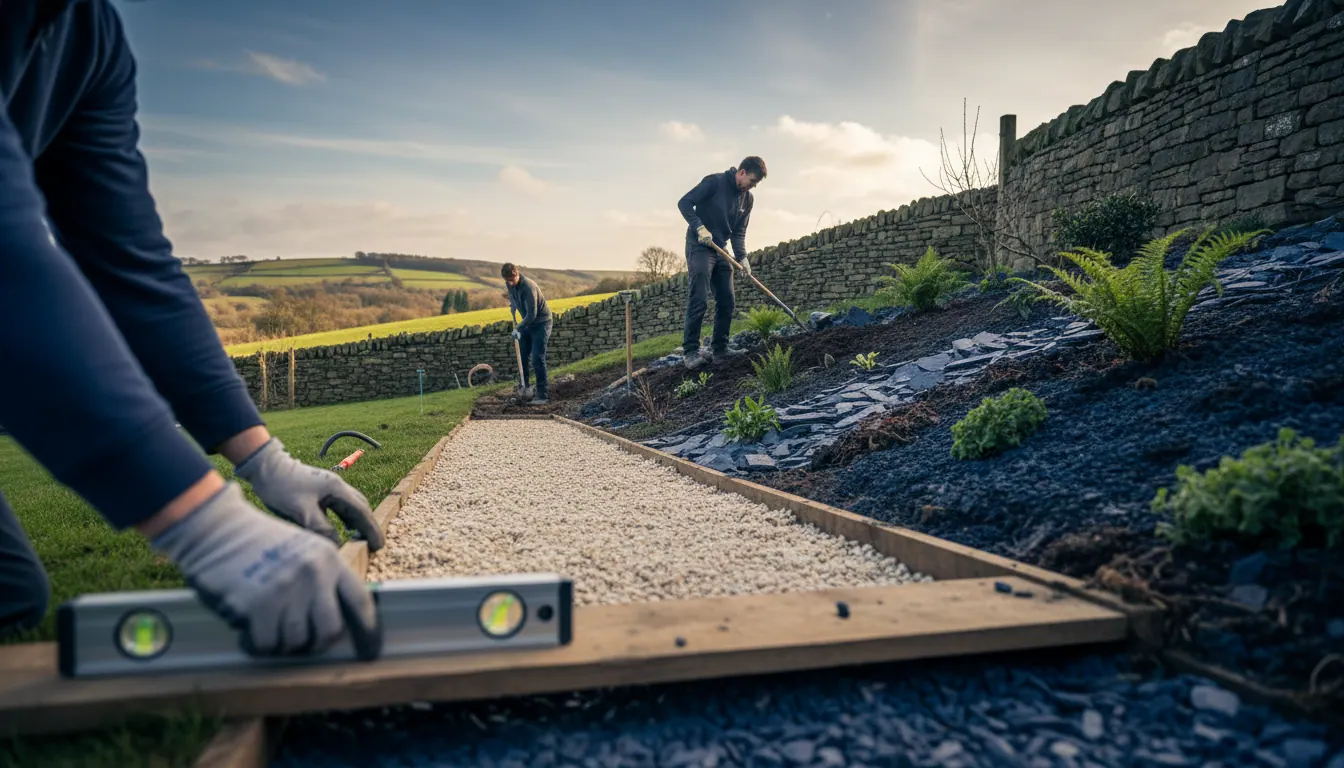
Sub-base and drainage layers. If we are laying a patio or any hard surface on a slope, the sub-base is where drainage is built in, not bolted on afterwards. We excavate properly, lay a compacted MOT Type 1 sub-base at the right depth, and ensure the finished surface has a consistent fall of around 1 in 80 away from the house. That fall is not guesswork. We set it with a level and we check it throughout. It is what stops water pooling against your back door.
French drains. On grassed or planted slopes, a French drain dug across the gradient can intercept water running down the slope before it reaches the house or pools at the bottom. We excavate a trench, line it with permeable membrane, fill it with clean angular stone, and lay a perforated pipe at the base. Where the water goes from there depends on the site: sometimes into a soakaway, sometimes to an existing drain. We do not connect to surface water drains without checking what is permitted.
Soakaways. Where there is no existing drainage outfall, a soakaway gives water somewhere to go. The size depends on the catchment area and the soil's permeability. In heavy clay, a soakaway alone is rarely enough, so we combine it with other measures. We are honest about that. A soakaway dug into solid clay is not a solution.
Retaining walls with drainage built in. On steep slopes, retaining walls are often part of the answer. But a retaining wall without drainage behind it will eventually fail. Water pressure builds up in the retained soil and pushes the wall forward. We build weep holes into retaining walls as standard, and we backfill with free-draining material so water can move through rather than building up.
Regrading. Sometimes the ground simply needs reshaping. If the fall is wrong, if there are hollows collecting water, or if the slope has eroded unevenly, we regrade it properly before doing anything else. That means bringing in or removing material, compacting it correctly, and setting the levels so water goes where it should.
Turfing and planting on slopes. Once the drainage is sorted, grass roots and plant roots help stabilise the slope and slow surface water. We turf on slopes regularly across West Yorkshire. The key is good soil preparation and the right seed or turf mix for the aspect and exposure. A north-facing slope in Huddersfield is a different proposition to a south-facing garden in Barnsley.
Why preparation decides whether it lasts
We say this to every customer: the work you cannot see is the work that matters. Anyone can lay turf over a muddy slope and make it look fine for a few months. The first wet autumn will tell you whether the drainage underneath was done properly.
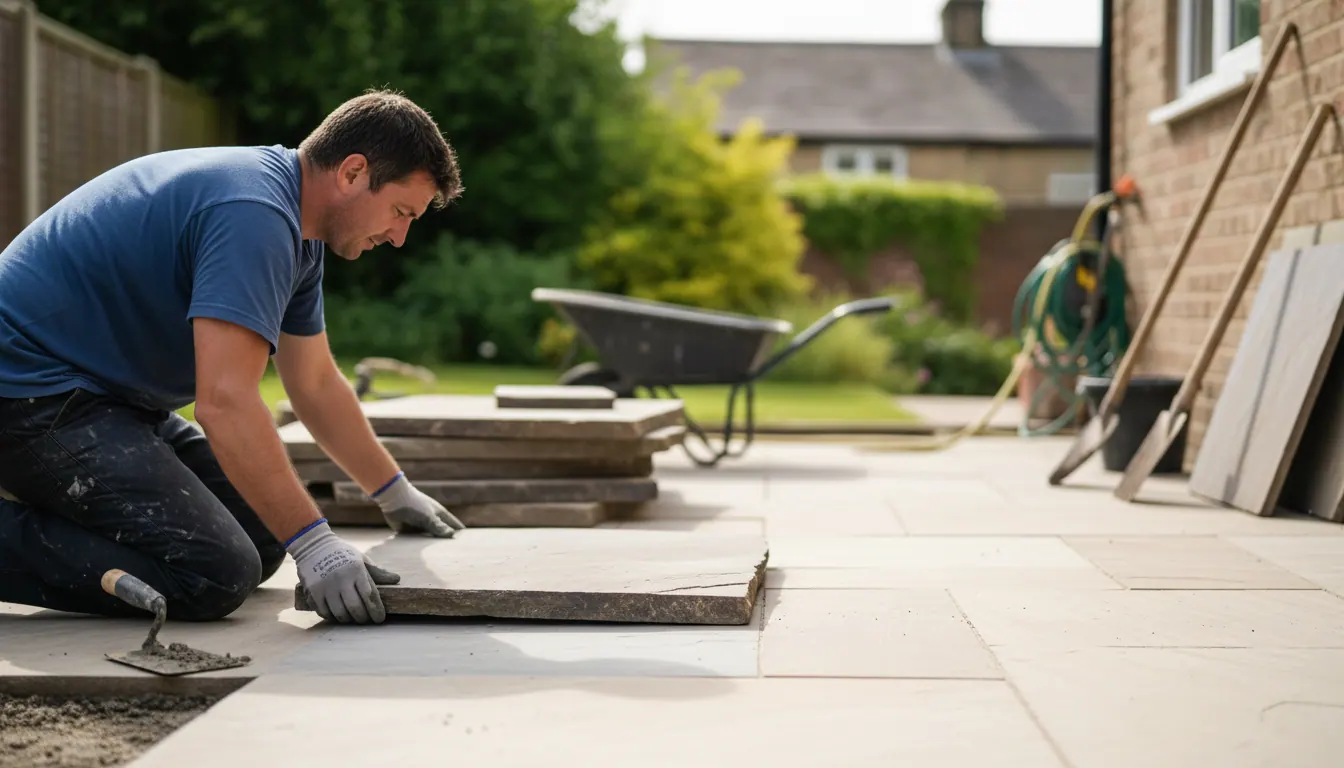
The same is true of paving. A patio laid without the right sub-base and falls will hold water, grow algae, and start to sink within a couple of years. We do not leave until it is absolutely pin-point perfect, because that standard is what makes the difference between a job that looks good in the photos and a job that is still right in ten years.
We treat every garden like it is ours. That means we do not cut corners on the groundwork just because it is out of sight.
Frequently asked questions
How do I know if my sloping garden has a drainage problem or just normal wet weather?
Normal wet weather means the garden is soft for a day or two after heavy rain, then recovers. A drainage problem means water is still standing two or three days after rain stops, the grass is dying off in patches, there is erosion on the slope, or water is tracking toward the house. If you are seeing any of those signs regularly, the drainage is not working.
Can you fix sloping garden drainage without ripping everything up?
Sometimes, yes. If the issue is a single blocked or collapsed drain, or if a French drain can intercept the problem without disturbing the whole garden, we can keep disruption to a minimum. But if the underlying levels are wrong or the sub-base is non-existent, there is no shortcut. Patching over a fundamental problem just delays the same issue coming back.
Do you work on sloping gardens across West Yorkshire and South Yorkshire?
Yes. We cover Huddersfield, Barnsley, and the surrounding areas across West and South Yorkshire. Sloping plots are very common in this part of the world and we work on them regularly. Every job starts with a free quote, so there is nothing to lose in getting us to look at it.
What time of year is best to sort out sloping garden drainage?
The honest answer is: before the wet season, not during it. Late summer and early autumn give us the best ground conditions to excavate, set levels, and lay drainage properly. If you wait until November when the ground is saturated, the work is harder and the results are harder to check. If your garden is already a problem, booking now means it is sorted before next winter.
Ready to stop losing your garden to mud and standing water?
If your slope is getting worse every year and you want it fixed properly, get in touch. We offer free quotes across West Yorkshire and South Yorkshire, including Huddersfield and Barnsley. We will come out, look at the site properly, and tell you exactly what needs doing and why.