Patio Drainage in Winter: Why Proper Falls and Jointing Matter in Batley and West Yorkshire
Patio drainage problems in West Yorkshire? We explain falls, sub-bases and run-off on clay and sloping ground in Huddersfield, Wakefield, Barnsley and beyond.

Why patio drainage goes wrong in West Yorkshire
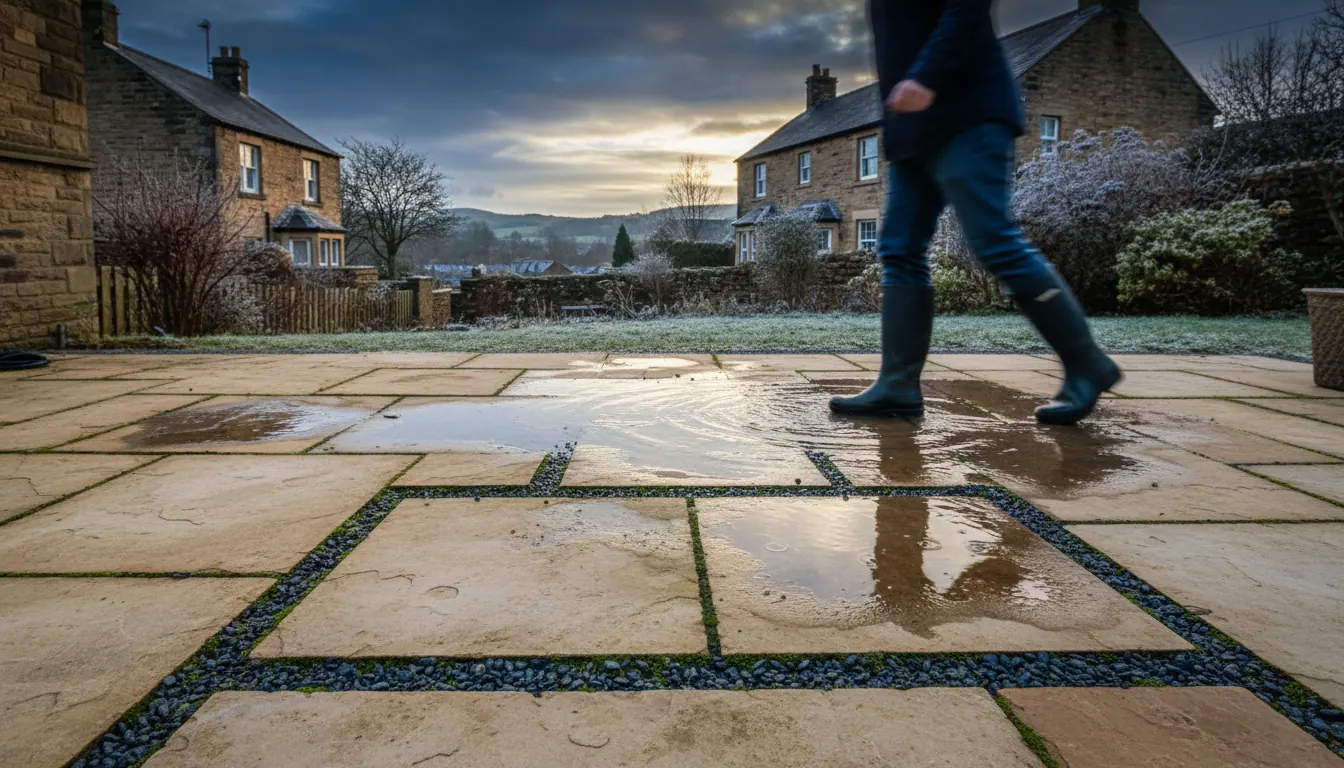
Puddles sitting on a patio two days after rain. Slabs rocking because frost has worked underneath them. A whole seating area slowly tilting back towards the house. These are not random bad luck. They are the result of drainage being treated as an afterthought rather than the foundation of the job.
West Yorkshire and South Yorkshire throw everything at a paved surface. High rainfall, heavy clay soil, hard frosts in exposed spots, and gardens that slope in three directions at once on the Pennine edge. A patio that drains correctly in a flat garden in a drier part of the country can still fail here if the builder hasn't accounted for the ground conditions.
We've been laying patios across Huddersfield, Wakefield, Barnsley, Dewsbury, Batley, Penistone and the surrounding areas for over 20 years. Drainage isn't a finishing touch. It's the first decision we make on every single job.
The fall: the most important number on any patio
A fall is the deliberate slope built into a paved surface so water moves away from the house and towards a proper outlet. Without a fall, water sits. With the wrong fall, it runs the wrong way.
The standard minimum fall for a patio is 1:80. That means 1 mm of drop for every 80 mm of run. On a 4-metre-wide patio, that's 50 mm of drop across the whole surface. It sounds small. Done badly, it's invisible to the eye and water still drains cleanly. Done carelessly, you end up with a surface that looks flat but pools in the middle.
We set our falls before a single slab goes down, using a level and string lines across the whole area. The sub-base is graded to the fall first. The bedding layer follows it. The slabs confirm it. If you get the fall right at sub-base stage, everything above it stays honest.
Falls must always run away from the house. On a sloping plot, that can mean running the fall across the width of the patio rather than straight back, or incorporating a channel drain along one edge. On the steep terraced gardens common around Batley and Huddersfield, we often need to think about where the water goes once it leaves the patio, not just how it leaves the surface.
Sub-base depth: where most drainage failures begin
The sub-base is the hardcore layer that sits beneath the bedding mortar and the slabs. It carries the load, provides stability and, critically, it determines how well the whole structure manages water movement.
On West Yorkshire clay, the minimum we lay is 100 mm of compacted MOT Type 1 hardcore. Clay doesn't drain. It holds water, swells when wet and shrinks when dry, and that movement will crack a patio that isn't sitting on a deep, stable base. On heavier clay ground or on slopes, we go deeper.
The sub-base has to be compacted properly with a plate compactor, not just raked flat. Loose hardcore compresses unevenly under load and the surface above it follows. We compact in layers, not all at once, and we check levels as we go.
On a sloping garden, particularly on the kind of Pennine-edge plots we work on around Penistone and the higher ground above Huddersfield, the sub-base also needs to be graded so water doesn't travel along the base layer and emerge at the edge of the patio. Getting this wrong means the patio looks fine for a year, then starts lifting at the lower edge as water undermines it from below.
Drainage channels and outlets: moving water off the patio
A well-graded fall gets water to the edge of the patio. You still need somewhere for it to go.
On smaller patios next to a lawn, the water can run off the edge onto grass and soak away naturally. That works fine if the lawn is lower than the patio and the ground drains reasonably well. On clay-heavy ground, or where the garden is enclosed, it isn't enough.
The options we use most often:
- Linear channel drains set into the patio surface, usually along the low edge or against the house wall, connected to a soakaway or the surface water drainage system. These are particularly useful on porcelain slabs, which are near-impermeable and shed water faster than natural stone.
- Gullies set at the lowest point, again connected to a soakaway or drain run.
- Soakaways dug into the garden at a suitable distance from the house, filled with clean stone and wrapped in geotextile membrane. On clay-heavy ground, soakaways need to be sized properly and positioned where the soil actually allows some percolation.
- Permeable jointing between slabs, using a brush-in jointing compound that allows a small amount of water to pass through the joint rather than building up on the surface. This helps on large patio areas where even a good fall can't move all the water fast enough in heavy rain.
On gardens in Barnsley and Wakefield where newer estates often have surface water drainage connections to the street, we can sometimes tie the patio run-off into the existing system. On older stone-built properties around Dewsbury and Batley, the drainage picture is more varied and we always check what's already there before we plan the outlet.
Clay soil and what it means for a patio in West Yorkshire
Most of West Yorkshire sits on heavy clay. It's worth being direct about what that means for a patio.
Clay doesn't drain. Water sits on it. In winter, it freezes and expands. In summer, it dries and contracts. That cycle of movement is what causes patios laid on inadequate sub-bases to crack, rock and sink.
The answer isn't to avoid laying patios on clay. It's to lay them correctly for clay. That means:
- A deeper sub-base than you'd need on sandy or gravelly ground.
- Compaction done in stages, not rushed.
- A sharp sand or dry mortar bedding layer that doesn't hold water against the underside of the slab.
- Drainage designed to remove water from the surface before it can sit and penetrate.
On gardens where the clay is particularly heavy and the slope means water concentrates in one area, we sometimes excavate deeper and install a drainage run beneath the sub-base level. It's extra work, but it's the difference between a patio that lasts fifteen years and one that needs lifting and relaying in five.
For more on how we approach difficult ground, our article on how to fix a muddy, sloping garden in West Yorkshire covers the drainage and levelling work that often happens before a patio can even be planned.
Porcelain vs Indian sandstone: does the material affect drainage?
Yes, and it's worth knowing before you choose.
Indian sandstone is a natural material with a degree of porosity. It absorbs a small amount of water through the surface, which helps take the edge off surface run-off in moderate rain. It also means the surface can stain if not sealed, and it needs a slightly lower fall tolerance to avoid pooling in the texture.
Porcelain is effectively impermeable. Water sits on the surface until the fall moves it. On a well-graded patio with a proper outlet, that's fine. On a patio with any low spots or insufficient fall, you'll see puddles every time it rains. Porcelain demands better drainage design, not because it's a worse material but because it doesn't forgive poor falls the way a more porous stone might.
We've written about why porcelain performs well in Yorkshire conditions in our article on porcelain patio slabs in Wakefield, which covers frost resistance and long-term wear alongside drainage.
Frequently asked questions
How much fall does a patio need to drain properly in West Yorkshire?
The standard minimum is 1:80, meaning 1 mm of drop per 80 mm of run. On a 4-metre patio, that's roughly 50 mm across the full width. In practice, on heavy clay ground or on exposed sites with high rainfall, we often aim for a slightly more generous fall to ensure water moves quickly and doesn't sit after heavy rain.
Can I add drainage to an existing patio that's pooling water?
Sometimes. If the fall is wrong and the slabs need lifting to regrade the sub-base, it's a significant job. If the fall is adequate but there's no outlet, fitting a channel drain along the low edge is more straightforward. We'd always assess the existing sub-base condition at the same time, because a patio that's pooling has often been sitting wet for long enough to compromise the base beneath it.
Does the type of soil in my garden affect how the patio drains?
Directly. On clay-heavy ground, which covers most of West Yorkshire and South Yorkshire, water doesn't soak away quickly beneath the patio. The sub-base needs to be deeper, the drainage design needs to actively move water off the surface and away, and any soakaway needs to be sized for the actual percolation rate of the soil on that specific plot.
What's the difference between a soakaway and connecting to the drain?
A soakaway is a pit filled with clean stone, buried in the garden, that allows water to disperse slowly into the surrounding ground. It works well where the soil has some permeability. On heavy clay, a soakaway can become overwhelmed in sustained rain. Connecting to a surface water drain is more reliable where it's available, but it requires checking that the existing system has capacity and that it's legal to connect to it on your specific property.
Get in touch
If your patio is pooling, lifting or running water towards the house, or if you're planning a new one and want it done right from the ground up, we quote every job individually once we've seen the ground and understood what's needed. Quotes are free.
Call us on 07359 173155 or send us a message on WhatsApp. We cover Huddersfield, Wakefield, Barnsley, Dewsbury, Batley, Penistone and the surrounding areas across West and South Yorkshire.