Composite and Timber Fencing in Penistone: Weathering Yorkshire Rain and Choosing the Right Material
Thinking about new garden fencing in Penistone or across South and West Yorkshire? We explain materials, heights and what makes a fence last.

Fencing in Penistone Takes a Bit More Thought Than Most Places
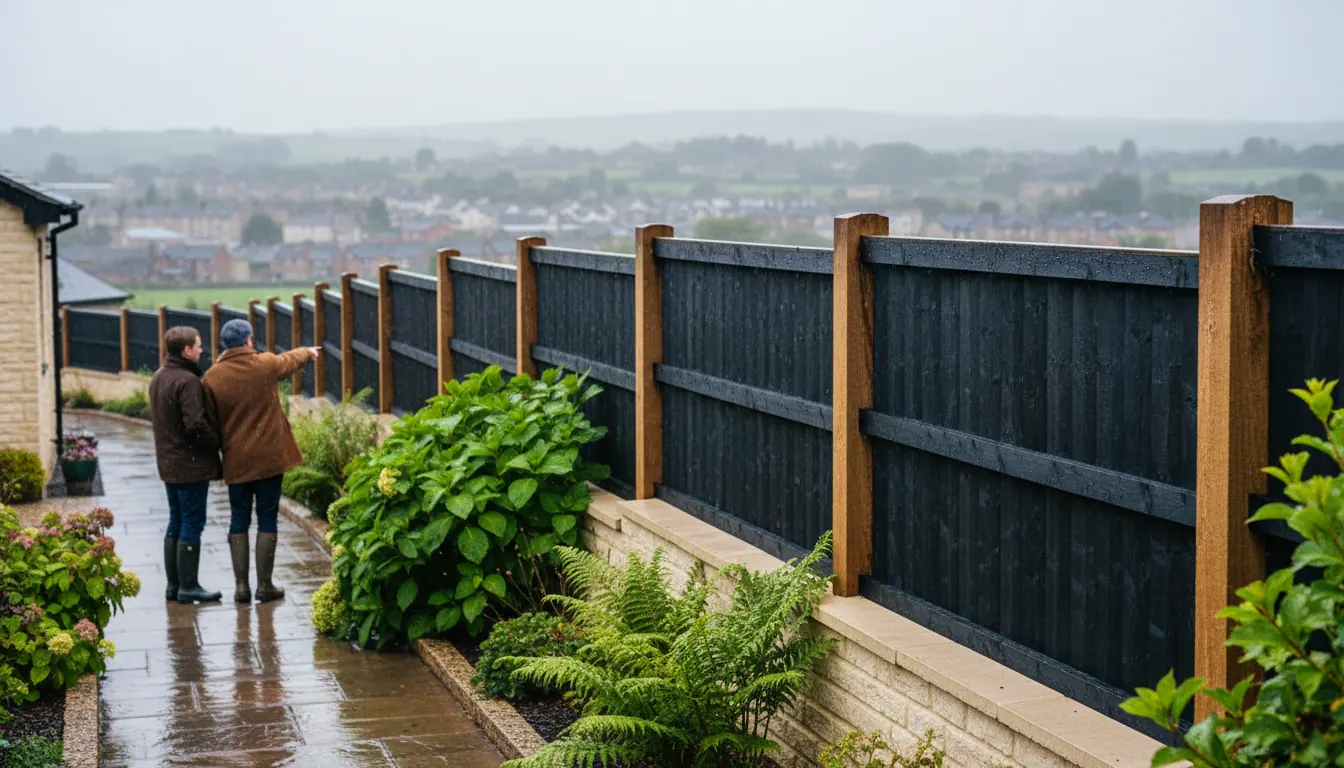
Penistone sits high on the Pennine edge. The wind comes in hard from the west, the ground is heavy and often waterlogged through winter, and a fence that would stand fine in a sheltered suburban garden can be rocking in its posts within a couple of seasons up here. We fit fencing across South and West Yorkshire, including Penistone, Barnsley, Huddersfield, Wakefield, Dewsbury, Batley and the surrounding areas, and the jobs we see fail most often fail for the same reason: the posts were not fixed properly for the ground conditions.
This article is about doing it right. The materials available, the heights that matter, and the preparation that decides whether your fence is still standing straight in ten years.
What the Ground Does to a Fence Post in Yorkshire
Heavy clay soil is the starting point for most gardens across this part of Yorkshire. It holds water, it swells when wet, and it shrinks when it dries out. That movement is what works fence posts loose over time, particularly if they were set with a spike rather than concreted in.
In Penistone and the higher ground around the Barnsley and Huddersfield fringes, you add frost to that. Water sitting around a post base freezes, expands and lifts. Do that enough times and even a post that was firm when it went in starts to shift.
The fix is straightforward: dig a proper hole, go deep enough (typically 600mm minimum for a standard panel fence, deeper for taller runs or exposed positions), use a post mix or concrete and let it cure before the panels go in. Spikes are a shortcut. They work in some soils. They are not the right choice for exposed, clay-heavy Yorkshire ground.
We always assess the ground before we advise on fixing method. That is not something to decide from a photo.
The Three Fencing Types We Install
We fit three types of fencing, and each suits a different situation.
Traditional timber panel fencing is the most common request. Featheredge boards fixed to arris rails, or closeboard panels in a frame. Timber is versatile, works with most garden styles, and can be stained or painted to suit the house. The downside is maintenance: it needs treating every few years, and in exposed, wet conditions it will degrade faster than in a sheltered garden. For Penistone gardens that take a battering through winter, the quality of the timber and the treatment matters. Pressure-treated posts and rails, not untreated softwood.
Contemporary slatted fencing has become one of our most requested styles over the last few years. Horizontal slats, usually with a gap between them, give a clean modern look that suits both newer builds and stone-built properties where you want something that reads as deliberate rather than just boundary marking. The slats can be timber or composite. This style does catch wind differently to a solid panel, and the fixing needs to account for that.
Composite fencing is the low-maintenance option. It does not rot, it does not need treating, and the colour holds for years. The upfront investment is higher than timber, but for homeowners who do not want to think about the fence again once it is in, composite is the honest recommendation. We have fitted composite fencing across Barnsley, Wakefield and Huddersfield for exactly this reason: people want a finish that stays looking right without annual work.
How High Can a Garden Fence Be?
This is one of the questions we get asked most often, and it is worth being clear about it.
In the UK, you can build a fence up to 2 metres high without needing planning permission, as long as it is not adjacent to a highway. If the fence borders a road or footpath, the limit drops to 1 metre before you need permission. These rules apply to most residential properties in England.
There are exceptions. If your property is in a conservation area, or if there are specific conditions attached to a planning permission (common on newer estates), different rules may apply. If you are not sure, check with your local council before the fence goes in. It is far easier to clarify beforehand than to deal with a retrospective issue.
For most back garden boundary fencing, 1.8 metres is the standard panel height and it falls comfortably within permitted development. For front gardens bordering a pavement or drive, 1 metre is typically the safe limit.
What Makes a Good Quality Fence Panel?
The question of quality comes down to a few things.
Timber density and treatment. Thin, lightweight panels with poorly treated timber will not last in Yorkshire conditions. Look for boards that have been pressure treated rather than just dipped, and check the thickness of the boards themselves. A closeboard fence with proper featheredge boards fixed to solid arris rails will outlast a thin prefabricated panel every time.
Post quality. The post is the structural element. A decent panel in a failing post is still a failing fence. We use posts that are sized correctly for the panel height and the ground conditions, and we never cut corners on the fixing depth.
Gravel boards. A gravel board at the base of the fence keeps the timber panels off the ground, where moisture and soil contact will rot them fastest. This single detail extends the life of a timber fence significantly. We fit them as standard.
Capping rails. A capping rail on top of the posts and panels keeps water from sitting on end grain. Again, a small detail that makes a real difference over time.
If you are choosing composite, the quality differences are in the density of the board, the quality of the fixing system and whether the posts are solid or hollow. We can talk through the options when we come to quote.
Fencing and the Wider Garden: How It Fits With the Rest of the Work
A fence does not exist in isolation. In a lot of the gardens we work on across Penistone, Barnsley and the surrounding areas, the fencing is part of a wider transformation: new patio, retaining walls, turf or artificial grass, raised beds. The order of work matters.
Fencing almost always goes in after groundwork and before the finish. If you are having a patio laid close to the boundary, or a retaining wall built to terrace a sloping plot, the fence needs to work with those levels. Getting the sequence wrong means undoing work, and that adds time and cost.
This is why we prefer to look at a garden as a whole project rather than just quoting for individual elements in isolation. If you are thinking about fencing alongside other work, tell us that from the start. It shapes how we plan the job.
For more on how we approach sloping gardens and retaining structures, which are very common in the Penistone and Huddersfield areas, have a read of our article on retaining walls and terracing for sloping Yorkshire gardens. And if you want a broader look at how fencing fits into garden design, our piece on garden fencing in Huddersfield: materials, posts and drainage for Yorkshire weather goes into more detail on the drainage side of things.
Why the Finish Matters to Us
We have been doing this for over 20 years. The standard we hold ourselves to is that we do not leave a job until it is absolutely pin-point perfect. That applies to fencing as much as it does to a patio or a full garden design.
A fence that is 5mm out of line, or posts that are not plumb, or panels that are not level: these things are visible every day to the person who lives there. We set out every run carefully, we check levels throughout and we do not rush the finishing details. That is what the finish means to us.
Frequently Asked Questions
What is the maximum height for a garden fence without planning permission in the UK?
In most residential situations, you can build a fence up to 2 metres high without needing planning permission. If the fence is next to a road or footpath, the limit is 1 metre. Conservation areas and new-build estates may have additional restrictions, so it is worth checking with your local council if you are unsure.
Which type of fencing holds up best in exposed Yorkshire conditions?
For high, exposed positions like Penistone and the Pennine-edge villages, composite fencing is the most durable option because it does not absorb moisture or degrade with frost. If you prefer timber, closeboard or featheredge construction with pressure-treated posts and a gravel board at the base will outlast standard panel fencing. The fixing method matters just as much as the material.
Do I need to tell my neighbour before putting up a fence?
If the fence is on your land, you do not legally need your neighbour's permission, but it is good practice to let them know, especially if it affects the light or outlook from their side. If there is any doubt about where the boundary sits, it is worth checking your title deeds before work starts.
Can fencing be fitted as part of a larger garden project?
Yes, and that is often the most practical way to do it. When fencing is part of a wider transformation, such as new paving, turfing, raised beds or retaining walls, we plan the sequence so each element works with the others. Getting in touch early and telling us the full scope of what you are thinking helps us give you a more accurate and useful quote.
Get in Touch
If you are thinking about new fencing in Penistone, Barnsley, Huddersfield, Wakefield, Dewsbury, Batley or the surrounding areas across West and South Yorkshire, we are happy to come and take a look. Quotes are free. Call us on 07359 173155 and we will arrange a time to visit.