Patio and Paving Season: Why Early Summer is the Right Time to Book in Dewsbury and Surrounding Areas
Thinking about a new patio this spring in West Yorkshire? Here's what proper preparation, drainage and laying really involves, from a team with over 20 years' experience.

Spring is when most West Yorkshire patios get built. Here's why that matters.
The ground firms up, the days lengthen, and suddenly everyone wants their garden sorted before summer arrives. Spring is our busiest season for patio and paving work across West Yorkshire and South Yorkshire, covering jobs in Wakefield, Barnsley, Dewsbury, Batley, Penistone and right across the Huddersfield area. If you're thinking about a new patio, this is the time to plan it properly rather than rush it.
But busy also means the good teams fill up fast. If you've been putting off booking, this article explains what the job actually involves, what separates a patio that lasts twenty years from one that starts rocking and staining within two, and what you should be asking any installer before they start.
What we mean by proper preparation
This is where most patios fail. Not the stone. Not the pointing. The preparation underneath.
A patio is only as good as what's beneath it. On a typical West Yorkshire garden, you're dealing with heavy clay soil that holds water, ground that moves with frost, and plots that often slope or step down from the house. Lay slabs straight onto compacted topsoil or a thin screed and you'll have movement, pooling and cracked joints within a couple of seasons.
What proper preparation looks like:
- Excavation to the right depth. For a full patio build we're typically digging out 150 to 200mm depending on the conditions, the material and whether the area takes foot traffic only or vehicle access.
- Compacted sub-base. MOT Type 1 hardcore, laid and compacted in layers. This is what carries the load and resists the freeze-thaw cycles you get on the Pennine edge through winter.
- Correct falls. Every patio needs to fall away from the house, usually around 1 in 60. Not steep enough to see with the naked eye, but enough to shift water clear. We check levels properly, not by eye.
- Bedding mortar. Mixed and applied consistently. Inconsistent bed depth is what causes slabs to rock and crack.
- Jointing. Done properly once the bed has cured. Rushed jointing, or pointing before the slabs have settled, leads to crumbling joints and weed ingress within a season.
None of this is glamorous. But this is what decides whether a patio looks the same in ten years as it does the day we leave.
Indian sandstone and porcelain: what suits West Yorkshire gardens
We work with both Indian sandstone and porcelain, and the right choice depends on the garden, the house and how the space will be used.
Indian sandstone is the natural choice for stone-built properties. It sits well against Yorkshire stone walls and period brickwork. It's warm underfoot, ages well, and the variation in tone across each slab gives a natural look that suits older gardens. The key with sandstone is sealing it properly and making sure the sub-base and falls are right, because a poorly drained sandstone patio will stain and grow algae fast in our climate.
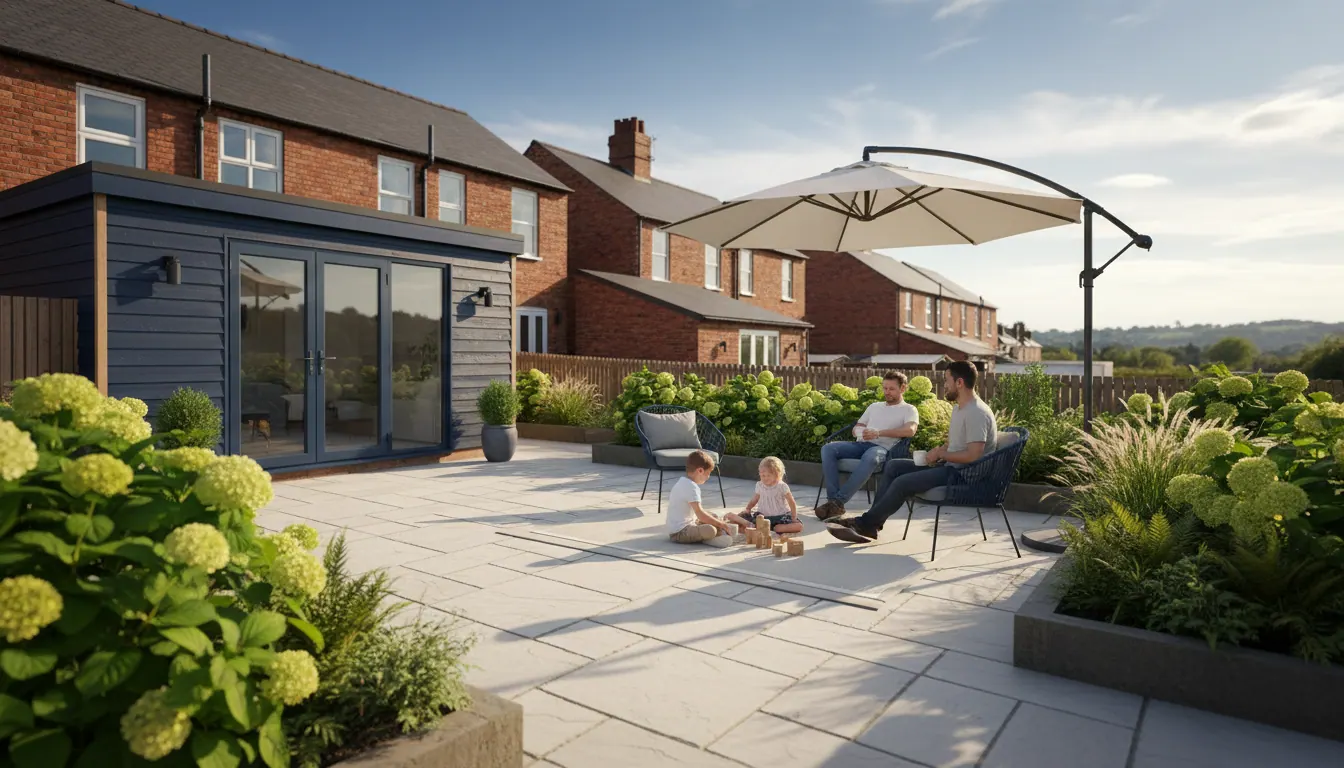
Porcelain suits contemporary builds and modern garden designs. It's harder wearing, less porous and easier to keep clean. It's particularly useful where a garden has a clean-lined design, composite fencing and raised beds. Porcelain requires a slightly different laying method because the slabs are denser and heavier, and the bed needs to be full and consistent, with no voids underneath. A hollow-sounding porcelain slab is a slab that will crack.
Both materials can look exceptional. Both will fail if the groundwork isn't right.
For more detail on what Indian sandstone installation involves, take a look at our article on Indian sandstone patio installation in Huddersfield: what proper preparation means.
Sloping gardens across West Yorkshire: the extra step most people don't plan for
A lot of the gardens we work on across Barnsley, Wakefield, Penistone and the Huddersfield area are not flat. Stone-built terraced properties, hillside plots, valley-bottom gardens that have been cut and banked over decades. Sloping ground adds complexity to any patio build.
The options are:
- Step down in levels. Create two or three distinct paved areas at different heights, connected by steps. This works well in longer gardens where you want to define zones.
- Retain and build out. Use a retaining wall to hold back the bank and create a flat paved area. Done properly, this opens up a garden that was previously unusable. Done badly, a retaining wall fails within a few years.
- Terrace the whole garden. Multiple levels, walls, steps and planting beds. This is a full transformation job and the kind of project we plan carefully from the outset.
If your garden slopes, the patio design has to account for it from day one. It's not something you solve after the slabs are down.
We've written more about this in our article on retaining walls and terracing: building usable spaces on sloping gardens in Yorkshire, which is worth reading if your plot has significant level changes.
Why spring bookings fill up, and what that means for you
Spring is the right time to lay a patio for practical reasons. The ground has had time to drain after winter. Temperatures are rising but not extreme. Mortar cures well in cool, dry conditions. And you have the whole summer ahead to use the space.
But spring is also when every homeowner in West Yorkshire has the same idea at once. We take on a set number of jobs each season, and once those slots are filled they're filled. We don't overbook and rush work to fit more in.
If you're planning a patio for this summer, the conversation needs to happen now. That means a free site visit, understanding what the ground is like, agreeing on materials and design, and getting the job scheduled. We offer free quotes, so there's no cost to getting that conversation started.
What a full patio build with us actually looks like
We treat every garden as if it's ours. That means we don't cut corners on the preparation because it's underground and you won't see it. We don't rush the jointing because we're keen to get to the next job. We don't leave until the finish is exactly right.
The steps on a typical patio installation:
- Site visit and free quote. We look at the ground, the levels, the drainage, what's there already.
- Agree on design, materials and layout. Edgings, steps, any walls or raised beds that form part of the space.
- Excavation and removal of spoil.
- Sub-base: hardcore laid and compacted in layers.
- Edge restraints set to the correct levels and falls.
- Bedding mortar mixed and applied.
- Slabs laid, cut and positioned.
- Jointing once the bed has cured.
- Clean down and final check. We don't leave a job until it's pinpoint perfect.
Over twenty years of doing this, the standard doesn't slip. The finish is everything.
Frequently asked questions
What time of year is best for laying a patio in West Yorkshire?
Spring and early summer are the most practical seasons. The ground is firm after winter, temperatures suit mortar curing, and you have the whole summer to enjoy the finished space. Autumn can also work well for the right job. What we avoid is laying in hard frost or waterlogged ground, because neither produces a reliable result.
How long does a patio installation take?
It depends on the size and complexity of the job. A straightforward patio for a typical semi-detached garden might take two to three days from excavation through to final jointing. A larger project with level changes, retaining walls and steps will take longer. We give you a clear timescale before we start and stick to it.
Do I need planning permission for a patio in West Yorkshire?
For most standard garden patios at ground level, planning permission is not required. If your property is listed, or if the work involves significant changes to drainage or ground levels near a boundary, it's worth checking with your local authority. We can advise on this during the site visit.
What should I look for when choosing a patio installer in West Yorkshire?
Ask about the sub-base. Ask about how they achieve and check the falls. Ask what happens if the ground conditions change once they start digging. Any installer who dismisses those questions or can't answer them in detail is not someone you want laying a patio that's supposed to last twenty years. The finish you see on the day is only as good as the preparation you can't see underneath it.
Ready to get your patio planned this spring?
If you're in West Yorkshire or South Yorkshire and you want a patio done properly, give us a call or drop us a message. We cover Huddersfield, Barnsley, Dewsbury, Wakefield, Batley, Penistone and the surrounding areas. Quotes are free, there's no obligation, and we'll come out to look at the garden and talk through what's involved before anything else.
Call us on 07359 173155 and let's get started.